
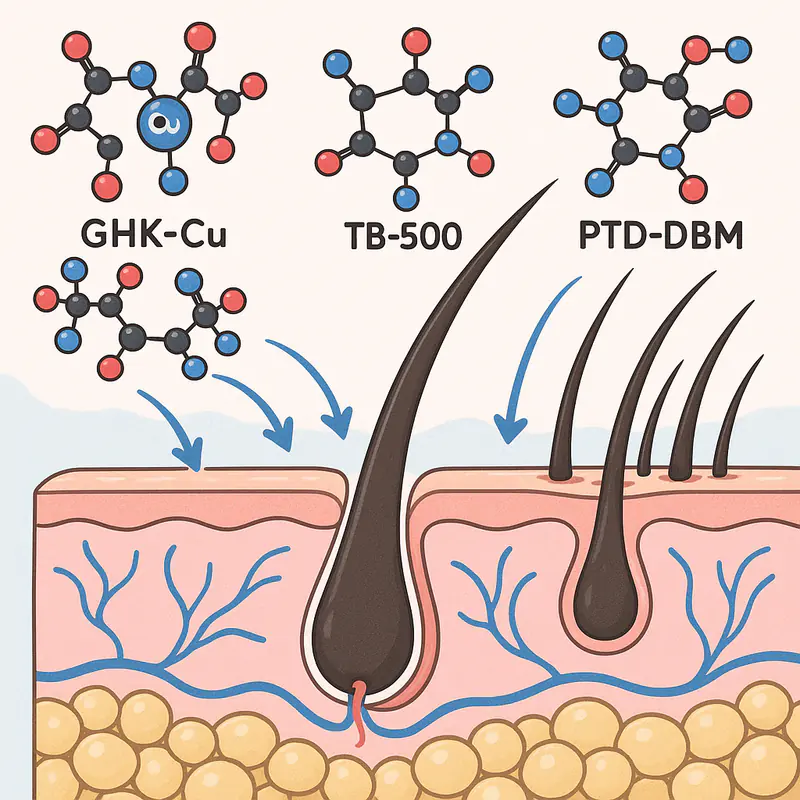
Hair Density as an Aesthetic Priority: Why Peptides Represent the Next Frontier
Within the looksmaxxing framework of systematic appearance optimization, hair density occupies a disproportionate position in perceived attractiveness. Research in facial perception consistently shows that hairline integrity, density, and hair quality significantly influence ratings of youth, health, and genetic fitness. For men, hairline recession is one of the earliest visible aging signals; for women, diffuse thinning dramatically affects perceived vitality.
Conventional hair loss interventions are effective but limited in scope. Minoxidil extends the anagen (growth) phase and increases follicle size through vasodilation but doesn't address underlying follicle biology. Finasteride blocks DHT conversion — useful for androgen-sensitive follicles but systemically consequential. Low-level laser therapy promotes mitochondrial activity in follicle cells but works slowly and modestly.
Peptide research has identified compounds that target hair follicle biology at a mechanistic depth these approaches cannot reach: activating stem cells in the follicle bulge region, modulating the Wnt/β-catenin signaling pathway that drives follicle cycling, stimulating dermal papilla cell activity, promoting angiogenesis in the scalp microvasculature, and directly countering the inflammatory processes that drive miniaturization. This guide examines the most evidence-supported peptides for hair optimization and what the research actually establishes.
GHK-Cu: The Most Researched Peptide for Hair Follicle Health
GHK-Cu (glycyl-L-histidyl-L-lysine copper complex, INCI name Copper Tripeptide-1) is the most extensively published peptide for hair applications, with a mechanism profile that addresses multiple simultaneous aspects of follicle biology.
Its effects on the hair cycle are documented through several distinct pathways. First, GHK-Cu modulates over 4,000 genes with direct involvement in hair cycling and follicle development — an unusually broad genomic reach that explains its wide-ranging effects. Among these, it specifically extends the anagen (active growth) phase and reduces catagen (regression) phase duration, directly improving terminal hair density and shaft thickness over time.
At the growth factor level, GHK-Cu stimulates VEGF (vascular endothelial growth factor) and HGF (hepatocyte growth factor) secretion from follicle cells, with studies showing up to 70% increases in VEGF production. This angiogenic effect — driving new blood vessel formation in scalp tissue — directly addresses one of the primary factors in hair follicle miniaturization: insufficient microvascular supply. Follicles in miniaturization zones consistently show reduced capillary density; restoring that supply is prerequisite to reversing the process.
GHK-Cu activates the Wnt/β-catenin pathway — a master regulator of follicle formation and cycling — and directly stimulates dermal papilla cells at the follicle base. It inhibits TGF-β, the transforming growth factor that drives premature follicle regression and fibrosis. It also increases Type I and III collagen production in the scalp dermis by up to 70% in laboratory models, maintaining the structural integrity of the extracellular matrix within which follicles are embedded.
Research published in the International Journal of Cosmetic Science confirmed increased hair density and reduced shedding from topical application. Injectable protocols in clinical settings have shown outcomes comparable to minoxidil in some comparative analyses, with advantages in tolerability. Mesotherapy delivery — micro-injections directly into the scalp dermis — allows GHK-Cu to reach dermal papilla cells directly, with clinical studies reporting 70% hair loss reduction within 4 months and 30% new regrowth in thinning areas.
Those researching GHK-Cu supplier options and concentration specifications often consult community resources; Peptidesgetonline compiles supplier comparison data used by researchers evaluating compound quality for topical and injectable hair protocols.
Thymosin Beta-4 (TB-500): Stem Cell Activation and Anagen Induction
TB-500, the synthetic version of the naturally occurring 43-amino acid Thymosin Beta-4, is best known in the research community for its systemic healing and connective tissue repair properties. Its role in hair follicle biology — specifically stem cell activation — is less widely discussed but equally compelling mechanistically.
The primary mechanism relevant to hair is TB-500's activation of hair follicle stem cells in the bulge region — the reservoir of multipotent cells that replenish the follicle's proliferative compartment with each growth cycle. Specifically, TB-500 promotes stem cell migration from the bulge toward the dermal papilla, facilitating the telogen-to-anagen transition. This transition is the fundamental switch that determines whether a dormant follicle re-enters active growth.
A study published in the Journal of Investigative Dermatology documented that Thymosin Beta-4 activated hair follicle stem cells and promoted hair shaft elongation in mouse models, with treated subjects showing approximately twice the number of anagen follicles compared to vehicle controls within the treatment period. Critically, the effects were reversible within approximately two weeks of cessation — suggesting that TB-500 drives ongoing stem cell activation rather than producing permanent follicle reprogramming, and that maintenance dosing would be required for sustained outcomes.
TB-500 also drives angiogenesis in follicle tissue through pathways complementary to GHK-Cu, promoting new capillary formation that supports the metabolically intensive demands of actively cycling follicles. In combination stacks, TB-500 and GHK-Cu are frequently paired because they target follicle health through distinct and non-overlapping mechanisms: TB-500 activates dormant stem cells and drives the anagen switch while GHK-Cu enhances the vascular infrastructure and growth factor environment those newly activated follicles require.
PTD-DBM: Rational Wnt Pathway Engineering for Follicle Neogenesis
PTD-DBM (Protein Transduction Domain-Dishevelled Binding Motif) represents a newer generation of rationally designed peptide therapeutics — engineered with a specific molecular target rather than discovered through empirical screening.
The Wnt/β-catenin pathway is the central regulatory hub of hair follicle cycling. In healthy follicles, Wnt signaling drives β-catenin into the nucleus where it activates transcription factors that initiate the anagen phase. CXXC5 is a negative feedback regulator that disrupts this pathway by binding to Dishevelled (DVL), a key upstream Wnt component, and preventing β-catenin stabilization.
PTD-DBM was designed to competitively inhibit the CXXC5-DVL interaction — essentially removing the brake on Wnt signaling in follicle cells. By protecting DVL from degradation, β-catenin levels accumulate, activating downstream Wnt cascades that promote follicle stem cell proliferation, anagen phase entry, and — in animal models with bald patches — follicle neogenesis: the formation of entirely new follicles from stem cell precursors.
Preclinical results showed PTD-DBM induced new follicle growth in mouse alopecia models. When combined with minoxidil, the combination produced superior hair density and follicle counts versus minoxidil alone — suggesting complementary rather than redundant mechanisms. However, human clinical trials remain limited, and whether the neogenesis effects observed in mice translate to humans is not yet established.
The PTD-DBM + GHK-Cu combination is mechanistically logical: PTD-DBM reactivates dormant follicles by unlocking Wnt signaling, while GHK-Cu provides the enhanced vascular supply, growth factor environment, and anti-inflammatory signaling that newly activated follicles need to fully cycle through anagen. This kind of mechanistically-informed stack design is covered in depth at Peptides Looksmaxxing, which documents protocol combinations and the biological rationale behind compound pairings for hair and aesthetic optimization.
Follistatin-344: Single-Treatment Durability and TGF-β Antagonism
Follistatin-344 is a 344-amino acid engineered peptide that acts as a potent antagonist of myostatin and activin — members of the TGF-β superfamily that inhibit stem cell proliferation in hair follicles and other regenerative tissues. By binding and neutralizing these inhibitory signals, follistatin removes a molecular restraint on follicle stem cell expansion.
A phase 1 clinical trial in 26 men with male-pattern baldness documented several notable outcomes from a single follistatin + growth factor injection: increased hair follicle count, 13% increase in hair thickness and density, and — most unusually — benefits sustained up to one year following a single treatment. No repeated administrations were required during the follow-up period.
The durability of single-treatment effects is mechanistically unusual among peptides and suggests a possible long-term stem cell reprogramming effect rather than simple transient stimulation. The one-year sustained response warrants further investigation in larger controlled trials, but the phase 1 signal is sufficiently distinctive to make follistatin-344 one of the more interesting compounds at the frontier of hair restoration peptide research.
Keratinocyte Growth Factor (KGF/FGF-7) and BPC-157 in Hair Protocols
Keratinocyte Growth Factor — a member of the fibroblast growth factor family produced by dermal papilla fibroblasts — acts as a paracrine signal driving epithelial cell proliferation in the follicle outer root sheath. At 10 ng/mL, recombinant KGF-2 stimulated 26–35% proliferation increases in human hair follicle cells in organ culture. Animal studies using recombinant KGF showed dose-dependent hair growth across large body areas, suggesting significant efficacy when the paracrine signal is amplified.
For practical application, KGF is most relevant as a target for upregulation — compounds that stimulate endogenous KGF production from dermal papilla fibroblasts may offer more sustainable effects than direct KGF administration. GHK-Cu's fibroblast activation and growth factor stimulation profiles partially address this by enhancing the paracrine signaling environment of the follicle.
BPC-157 rounds out the comprehensive hair peptide stack through its angiogenic and anti-inflammatory contributions. Preclinical animal models show hair follicle development acceleration and regrowth from BPC-157 treatment. Its primary value in hair-focused stacks is in creating the vascular and inflammatory conditions that enable other peptides' follicle-direct effects: new capillary formation, systemic inflammation reduction, and tissue repair capacity that prevents scalp microenvironment degradation from training stress or subclinical inflammatory states.
DHT, Miniaturization, and Why Peptides Offer a Complementary Approach
A common misconception in discussions of hair peptides is that they need to replace DHT-blocking strategies. They don't — they operate through different mechanisms and are most logically used in combination.
DHT (dihydrotestosterone) acts on androgen-sensitive follicles by shortening the anagen phase and inducing follicle miniaturization over successive cycles. Finasteride and dutasteride block its production; topical saw palmetto and certain zinc-based compounds reduce its local conversion. None of these restore follicle biology — they only slow the DHT-driven process.
Peptides operate downstream of DHT signaling. GHK-Cu's Wnt/β-catenin activation, TB-500's stem cell mobilization, and PTD-DBM's CXXC5 inhibition create a counter-force: strong growth signals that may compete with DHT's miniaturizing influence. Activated, proliferating stem cells appear more resistant to DHT-induced apoptosis. Improved microvascular supply reduces the metabolic vulnerability that makes DHT-stressed follicles prone to regression.
The most mechanistically complete approach combines DHT management (pharmaceutical or natural) with peptide-based follicle activation — blocking the destructive signal while simultaneously strengthening the regenerative capacity. Detailed protocol guidance on this combined approach is available at Clavtides, a reference resource for researchers approaching hair optimization with compound combination strategies.
Administration Routes and Protocol Frameworks
Hair peptide administration routes vary by compound and target depth:
Topical serums are standard for GHK-Cu, with 1–3% concentrations applied once or twice daily to the scalp. Topical application reaches the upper dermis and provides meaningful follicle-adjacent concentrations without systemic exposure. Results timeline: 4–8 weeks for improved hair quality; 8–16 weeks for visible new growth; 4–6 months for meaningful density gains in thinning areas.
Scalp mesotherapy — micro-injection via 30–32 gauge needles into the scalp dermis — delivers peptides directly to the dermal papilla microenvironment. Clinical studies report 70% hair loss reduction within 4 months and approximately 30% new regrowth from GHK-Cu mesotherapy protocols. Cost per session ranges from $150–$450; protocols typically involve 6–10 initial sessions followed by monthly maintenance.
Systemic subcutaneous injection is standard for TB-500 (2–5 mg biweekly in research protocols) and BPC-157 (250–500 mcg daily). Systemic administration creates whole-body tissue distribution that addresses scalp microenvironment factors through systemic anti-inflammation, angiogenesis, and growth factor upregulation.
Combination stacking logic for comprehensive hair optimization: GHK-Cu topically or via mesotherapy as the foundation layer (follicle stimulation and vascular support), TB-500 subcutaneously for stem cell activation and anagen induction, PTD-DBM for Wnt pathway optimization in refractory or severely miniaturized areas, and BPC-157 to maintain the anti-inflammatory and angiogenic environment that allows the other compounds to work.
What the Research Establishes and What It Doesn't
Hair peptide research, like most peptide research, exists on a spectrum from strong mechanistic evidence to limited human clinical data. GHK-Cu's effects on follicle stem cells, growth factors, and scalp vascularity are well-mechanistically characterized and have preliminary human clinical support. TB-500's stem cell activation is confirmed in preclinical models with reversible effects. PTD-DBM's Wnt pathway mechanism is clearly established; human neogenesis translation is not yet confirmed. Follistatin-344's phase 1 data is intriguing but from a single small trial.
None of these compounds are FDA-approved for hair loss treatment in humans. All represent research-stage interventions. Individual response rates in mesotherapy studies range from 38% to 100%, highlighting the significant role of genetic factors, baseline follicle viability, and scalp health in determining outcomes.
For the evidence-based looksmaxxer, hair peptides represent a frontier with compelling mechanistic foundations and growing clinical support — but one that requires realistic expectations, appropriate medical supervision, quality-verified compound sourcing, and the understanding that no peptide protocol will restore follicles that have been permanently destroyed. Viability of remaining miniaturized follicles, not irreversible fibrosis, is the prerequisite for peptide hair intervention to show meaningful results.
Conclusion: Building a Mechanistically Complete Hair Optimization Protocol
The convergence of vascular biology, stem cell science, and Wnt pathway research has created a set of peptide tools that target hair follicle health with a mechanistic precision conventional treatments cannot match. GHK-Cu addresses vascular supply, growth factor signaling, and gene modulation. TB-500 activates dormant stem cells. PTD-DBM unlocks Wnt pathway signaling in miniaturized follicles. Follistatin-344 removes TGF-β inhibitory signaling. BPC-157 maintains the tissue environment.
Used in combination with DHT management strategies and optimized scalp health practices, this peptide toolkit represents one of the most sophisticated approaches to hair density restoration available to the serious looksmaxxer. The evidence base, while still building, is mechanistically coherent — and the rate at which clinical data is accumulating suggests the frontier will look considerably clearer within the next five years of research.